Okay, so what's this bible everybody talks about?
The word bible literally means book.
Right. It's a book. So what's the big deal?
The Bible (capital "B") is what Christians call God's word. Sometimes it's referred to as the Holy Scriptures or the Holy Bible. Any authoritative book can be called a bible (lower case "b"), but on this blog, the word Bible will refer to the book containing the Word of God.
Yada yada yada. What makes it so important?
Well, God's word is important.
Who's God?
God is the creator of the universe.
Wait a minute. I thought the universe or world or whatever was created by that Big Bang thing and then "evolution" took care of the rest.
No. In the first book of the Bible (Genesis 1:1), God says: "In the beginning God created the heavens and the earth."
You said the Bible was a book. Now there's a book of the Bible?
Right. The Bible is made up of 66 books.
That doesn't make any sense. If a book is divided into sixty-six parts, each part is usually called a chapter, not another book.
Generally, yes. Divisions of books are called chapters. However, the Bible is a collection of 66 "books", each divided into numbered chapters and verses.
Verses? Is the Bible some sort of poetry? I don't like poems.
The Bible contains some poetry, but the verses I'm referring to are just numbered units of chapters. The numbers themselves don't mean anything; they are merely a way of locating certain ideas or thoughts. They are numbered so that it is easy to find parts of the Bible that we are looking at or studying. It is similar to finding a person by using their physical address. First, I would need to know what country a person lives in (Country=Bible in this scenario). Then I would need to know the state/province/region to narrow it down (State=book of the Bible). Next I would need the city/town/village (City=chapter number). Lastly, I would need to know the street address or post office box number (Street address/PO box=verse number). In the United States, we rarely label mail "USA", we just use the street address, city, and state (and zip codes). Similarly, when we reference the Bible, we rarely say "Bible" "book" "chapter" "verse". We just say the book's name, chapter, and verse. So when you see something like Genesis 1:1, it means the portion of the Bible I'm quoting is from the book called Genesis, the first chapter and the first verse. I would just say it as "Genesis chapter one, verse one." If you pick up a copy of the Bible, you can find the quote.
Okay, so I found a Bible and looked up Genesis 1:1. Your quote is worded a little bit different than mine. How come?
The Bible was not written in the English language. The Old Testament was written in Hebrew. The New Testament was written in Greek. When we read the Bible in English (or any language other than Hebrew or Greek), we are reading a translation. Your translation might be worded differently than mine.
Whoa. Hold up. What is a testament and why is one old and the other new? I thought we were talking about the Bible.
We are talking about the Bible. I've already mentioned there are 66 books, each divided into their own chapters and verses. There is another division of sorts. The books of the Bible written before the birth of Jesus are called the Old Testament; the books of the Bible written after Jesus was born (and died, and rose from the dead, and ascended into heaven) are called the New Testament. A testament is something (in this case, a collection of accounts recorded in the Bible) that serves as a sign or evidence of a specified fact or event (in this case, God's love and mercy).
You keep saying there are 66 books in the Bible, but the Catholic church says there are 73. Who's right? You or the Pope?
There are many differences between the Pope and I. I claim sixty-six books of the Bible. The Catholic church has additional books that they believe are God's word. Those books are referred to as the Apocrypha or deuterocanonical. The WELS website has articles which mentions this issue here and here. The second link is especially helpful. If either link doesn't work, simply go to wels.net and type apocrypha into the search box.
Yeah, I don't really like to click on links. Just sum it up for me.
The extra books (Apocrypha) were written before Jesus' birth. While Jesus lived on earth, he said "Everything must be fulfilled that is written about me in the Law of Moses, the Prophets and the Psalms." (Luke 24:44). The extra books were not included in that group. In addition, some of the teachings in the Apocrypha contradict the Law of Moses, the prophets, and the psalms. In my opinion, the Catholic church is in error by claiming the Apocrypha as God's word.
What does it matter? Who cares if Catholics read extra books?
This brings us back to your earlier question: What makes the Bible so important? I've already mentioned that the Bible is God's word, and God is the creator of the universe. God created you and me, as well. The first man God created was called Adam. God created a helper for Adam, a woman called Eve. He placed them in a garden to live. He gave them one rule: don't eat from that one tree. Eve ate fruit from that tree, and gave some to Adam to eat as well. They broke the one rule they had. When someone breaks God's rules, we call that sin. When rules are broken, there are repercussions; there are consequences to our actions. When Adam and Eve sinned, God kicked them out of the garden (called Eden) and wouldn't let them eat from the tree of life any more. In other words, their punishment was death (a forever separation from God). God loved Adam and Eve, though. He promised them a Savior would come when he said to the serpent/deceiver (aka the Devil): "I will put enmity [hostility] between you and the woman, and between your offspring [unbelievers] and hers [believers]; he [the Savior] will crush your head, and you will strike his heel." (Genesis 3:15, words in brackets added by me). God's word is important. We all die (everyone agrees on this) because we are all sinful. The Bible tells us so. It also tells us of our Savior. The Bible tells us what will happen when we die. Jesus promises those who have faith in him: "I tell you the truth, today you will be with me in paradise." (Luke 23:43) And to those who have rejected Jesus as their Savior, they "will be thrown outside, into the darkness, where there will be weeping and gnashing of teeth." (Matthew 8:12) The Bible does two things: 1) shows us our sins, 2) shows us our Savior (Jesus Christ). Any message which distracts from, detracts from, or denies a need for Jesus, is dangerous and puts our life after death in danger of hell.
Whoa. That's way more than I wanted to know.
Sometimes I get a little carried away.
So, I'm not much of a reader and the Bible looks super long. Can't you just tell me about it? Or is there a movie I can watch?
The Bible is how God talks to us. It's important to listen to him. He warns us of danger (sin and its consequences) and tells us how to be saved from danger (Jesus is the way). I could tell you, but how do you know that what I'm telling you is the truth? People will lie; God will not. You can walk into any church you see, but how will you know if they are preaching God's truth if you don't know what God actually says (all written down for you in the Bible)? You can watch movies about Jesus and the Bible. Some of them are true, some are not. The easiest, simplest way to know what God says is by reading the Bible.
Okay, geez. But do I have to read the whole thing?
I'm probably not the best person to ask that question, since I have personally made my way through the entire Bible a couple of times, and I enjoy reading as a hobby. My answer is yes! You should want to read the whole Bible! But do you have to read the entire Bible to go to heaven? The answer is no. You need to repent of your sins and have faith in Jesus' salvation to go to heaven. That's it. I'd like to add that "faith comes from hearing the message, and the message is heard through the word of Christ." (Romans 10:17) So I definitely encourage you to read the Bible.
Where should I start? Do I have to begin at the beginning?
The first four books of the New Testament (Matthew, Mark, Luke, John) are a great place to begin. They each give a perspective of Jesus' life, death, and resurrection. Some copies of the Bible will use red ink when Jesus is speaking, and that's kind of cool. If you want to begin at the beginning, start with Genesis. If you like music, you may be interested in Psalms. If you're just beginning your exploration of the Bible, you might want to take a look at a children's Bible; it might not seem as intimidating as a regular Bible.
How much does a Bible cost?
Prices vary, but some copies cost less than $10. Salvation Army gives Bibles away free. Other thrift stores might have the Bible at reduced prices. Also, if you have a library nearby, you might check to see if they have the Bible available there. If you have an e-reader, you can download a sample of the Bible and read a little bit of it that way. You can stop by any Christian church and ask to read a Bible; if they don't have Bibles available to read, you might want to check another church. Some churches might not be able to let you take it home with you, but I imagine they would welcome you back as often as you cared to return. You can also find the Bible on the Internet. Thanks to the United States' freedom of religion, the Bible is easily accessible.
I noticed there are a bunch of different translations and versions available. Which one do I get?
I personally enjoy the NIV (New International Version) with the 1984 copyright, but that may be because it's the one I grew up reading and hearing in church. I would recommend you avoid the King James' version (KJV), since it uses outdated pronouns (thy and thou) and may be uneasy to read, but it's really a matter of preference.
Okay, so I'm reading the Bible and I just don't get it. What do I do now?
You might want to buy or borrow a copy of one of the People's Bible series books. I've just discovered these, and they're awesome. Here is a link to Matthew written by G. Jerome Albrecht and Michael J. Albrecht. You can also use the WELS church locator and contact a WELS pastor near you. They have studied the Bible in the original languages (Greek and Hebrew) and can help you to understand the issues that might be troubling you.

Friday, March 6, 2015


Evangelism and an Introduction
This is my first evangelistic post. What is evangelism? Evangelism is the spreading of Christian gospel by personal witness. So basically, I'll be telling you the good news about Jesus. If you don't know who Jesus is, don't worry; I'll tell you: He's God's son, the Savior of the world. If that answer brings up more questions, this is the place for you! I'm planning a series of posts in which I'll ask questions, answer them, ask follow-up questions, and answer those! Super exciting, right? If you have questions that I didn't answer (or ask), or if you don't understand the answers I've given, or if you don't agree with my answers, please leave a comment. I'll do my best to answer your comment and/or direct you toward finding the answer in another way. I plan on starting simple. Here are some subject areas I have in mind for posts:
• The Bible
• Death
• Baptism
• Holy Communion/the Lord's Supper/Eucharist
• Church/worship
• Sin
• Forgiveness
• Sexual immorality
• Repentance
• Different religions
• Apostles/disciples
• Who's who in the Bible
• Christian freedom
At this point, you may be wondering who I am. What are my qualifications? What religion am I? Why should you listen to me?
I am Molly Kuxhaus. I am a sinner. I am a saint. I am a Christian. I am God's child. It is by grace I have been saved, not by anything I have done. I have done horrible things, thought detestable thoughts, and sinned in many ways. Jesus, my Savior, never sinned. I deserve punishment for my sins; Jesus does not/did not deserve punishment. I was declared innocent because Jesus was declared guilty. He paid for my sins. He took the punishment I earned. God loves me so much, he was willing to accept Jesus' death as payment for my debt. I am not perfect. I am forgiven. Jesus' perfect life and innocent death paid for the sins of the whole world, including yours.
What are my qualifications? I have not attended seminary. As a woman, I am not permitted authority over a man, and thus may not pursue a pastoral ministry that includes men as members. Many women may consider this to be sexist and an outrageous inequality. God created Adam (man) first. God created Eve (woman) to be a helper and companion for Adam. In doing so, he established man as the head of the household, and head of the church. I respect God, and I respect his establishments. I am a laywoman, which basically means I am a female member of a church. I attend church on a regular, weekly basis. I read the Bible daily. As for secular education, I graduated magna cum laude from the University of South Dakota with a BS in English. I minored in mathematics.
What religion am I? I am a member of the Wisconsin Evangelical Lutheran Synod, commonly referred to as the WELS. There are many Lutheran churches, and the beliefs vary. To merely say I am Lutheran may misconstrue my beliefs, since some Lutheran denominations have veered from the Bible. The WELS has a very nice website, and is full of information and devotions. It has a WELS locator link at the top of the home page so that you can find the closest WELS church in your area. There are other churches (not in the WELS synod) where the truth about God may be preached, but the WELS reliably trusts in the Bible. Not what the minister thinks or believes, but what the Bible says. WELS ministers are trained in the languages that the Bible was originally written in (Greek and Hebrew), so that they are not misguided by errant or unclear translations of the Bible. They are sinners, just like you and me, and they struggle with sin, as we do. Their job is to point you to the One who has never sinned (Jesus) for forgiveness.
Why should you listen to me? I would prefer you go to church and hear the Word of God preached. I would prefer you spent your time reading the Bible instead of my posts. If you are afraid of going to church because you don't think you know enough about God to attend, hopefully my posts will prepare and encourage you to go. You don't really need to know anything before going to church; there are no preparations you need to make. It helps to know what God says in his Bible, so that you find a church that preaches the true Word of God. The WELS is a great source. If you are intimidated by the Bible (it is a rather large volume), hopefully my posts will make you more comfortable with it.
Please keep in mind that I have not attended seminary, and I am not an authority. I am merely trying to share my faith in hopes that you will come to know the One who loves you so much He died for you. Consider this a preschool of sorts, something like a wading pool. I'll try to keep things simple and fun.
Here's the gospel in a nutshell: "For God so loved the world that he gave his one and only Son, that whoever believes in him shall not perish but have eternal life." (Holy Bible, John 3:16)
• The Bible
• Death
• Baptism
• Holy Communion/the Lord's Supper/Eucharist
• Church/worship
• Sin
• Forgiveness
• Sexual immorality
• Repentance
• Different religions
• Apostles/disciples
• Who's who in the Bible
• Christian freedom
I am Molly Kuxhaus. I am a sinner. I am a saint. I am a Christian. I am God's child. It is by grace I have been saved, not by anything I have done. I have done horrible things, thought detestable thoughts, and sinned in many ways. Jesus, my Savior, never sinned. I deserve punishment for my sins; Jesus does not/did not deserve punishment. I was declared innocent because Jesus was declared guilty. He paid for my sins. He took the punishment I earned. God loves me so much, he was willing to accept Jesus' death as payment for my debt. I am not perfect. I am forgiven. Jesus' perfect life and innocent death paid for the sins of the whole world, including yours.
What are my qualifications? I have not attended seminary. As a woman, I am not permitted authority over a man, and thus may not pursue a pastoral ministry that includes men as members. Many women may consider this to be sexist and an outrageous inequality. God created Adam (man) first. God created Eve (woman) to be a helper and companion for Adam. In doing so, he established man as the head of the household, and head of the church. I respect God, and I respect his establishments. I am a laywoman, which basically means I am a female member of a church. I attend church on a regular, weekly basis. I read the Bible daily. As for secular education, I graduated magna cum laude from the University of South Dakota with a BS in English. I minored in mathematics.
What religion am I? I am a member of the Wisconsin Evangelical Lutheran Synod, commonly referred to as the WELS. There are many Lutheran churches, and the beliefs vary. To merely say I am Lutheran may misconstrue my beliefs, since some Lutheran denominations have veered from the Bible. The WELS has a very nice website, and is full of information and devotions. It has a WELS locator link at the top of the home page so that you can find the closest WELS church in your area. There are other churches (not in the WELS synod) where the truth about God may be preached, but the WELS reliably trusts in the Bible. Not what the minister thinks or believes, but what the Bible says. WELS ministers are trained in the languages that the Bible was originally written in (Greek and Hebrew), so that they are not misguided by errant or unclear translations of the Bible. They are sinners, just like you and me, and they struggle with sin, as we do. Their job is to point you to the One who has never sinned (Jesus) for forgiveness.
Why should you listen to me? I would prefer you go to church and hear the Word of God preached. I would prefer you spent your time reading the Bible instead of my posts. If you are afraid of going to church because you don't think you know enough about God to attend, hopefully my posts will prepare and encourage you to go. You don't really need to know anything before going to church; there are no preparations you need to make. It helps to know what God says in his Bible, so that you find a church that preaches the true Word of God. The WELS is a great source. If you are intimidated by the Bible (it is a rather large volume), hopefully my posts will make you more comfortable with it.
Please keep in mind that I have not attended seminary, and I am not an authority. I am merely trying to share my faith in hopes that you will come to know the One who loves you so much He died for you. Consider this a preschool of sorts, something like a wading pool. I'll try to keep things simple and fun.
Here's the gospel in a nutshell: "For God so loved the world that he gave his one and only Son, that whoever believes in him shall not perish but have eternal life." (Holy Bible, John 3:16)
Sunday, April 28, 2013
No-Bake Fudge Nougats
No-Bake Fudge Nougats
1/2 c (1 stick) butter
2 c sugar
1 c evaporated milk (2/3 c dry non-fat milk; 3/4 c water)
1 c chocolate chips
3/4 c flour
1 c graham cracker crumbs
3/4 c chopped nuts
1 t vanilla extract
In a saucepan combine sugar, butter, and evaporated milk. Cook, stirring constantly, until mixture comes to a boil; boil, stirring occasionally, for 10 minutes. Remove from heat. Blend in chocolate chips, flour, cracker crumbs, nuts, and vanilla. Beat until thick. Spread in well-greased, 9-in square pan.
– Alta Moody, Platteville, Wisconsin
Tuesday, April 23, 2013
Sloppy Joe Sandwiches to serve 100
The following is from Taste of Home magazine, April/May 1993.
Sloppy Joe Sandwiches
20 lbs lean ground beef
3 c. chopped onions
1/4 c. Worcestershire sauce
1 lb brown sugar
1 c prepared mustard
2 T chili powder
1 gallon ketchup
Salt, to taste
Pepper, to taste
Hamburger buns
Brown beef; drain fat. Add the next seven ingredients; simmer or cook in an electric roaster for 1 hour. Stir occasionally. Serve on buns. Yield: about 100 servings
Editor Karen Ann Bland of Gove, Kansas shared the recipe. She wrote, "This recipe comes from a renowned local cook who was the lunchroom cook when my husband, Boyd, went to grade school. We now use it for our annual Gove Old Settlers Day supper in summer."
If serving 100 is more than you had in mind, you might like this recipe for Sloppy Joes which serves 16.
Editor Karen Ann Bland of Gove, Kansas shared the recipe. She wrote, "This recipe comes from a renowned local cook who was the lunchroom cook when my husband, Boyd, went to grade school. We now use it for our annual Gove Old Settlers Day supper in summer."
If serving 100 is more than you had in mind, you might like this recipe for Sloppy Joes which serves 16.
Monday, April 22, 2013
Serving for 100
The following is from Taste of Home magazine, April/May 1993.
Here are suggested guidelines for amounts needed to feed a group of 100 people. (Serving sizes vary depending on the type of crowd and meal served.)
Meats
Bacon: 20-25 lbs
Beef Roast: 50 lbs
Chicken: 55-60 lbs
Fish: 25 lbs
Ground Beef: 20-25 lbs
Ham (with bone): 35-40 lbs
Pork Roast: 35 lbs
Spare Ribs: 75 lbs
Stewing Beef: 25 lbs
Turkey: 75-100 lbs
Wieners: 20 lbs
Vegetables
Baked Beans: 12 lbs
Carrots: 25-30 lbs
Celery: 10-12 bunches
Lettuce (for salad): 12-15 heads
Potatoes (for mashed): 35 lbs
Potatoes (for scalloped): 35-40 lbs
Squash: 50 lbs
String Beans: 20-35 lbs
Sweet Potatoes: 25 lbs
Tomatoes: 25-38 lbs
Fruit
Canned fruit: 20-25 cans, 25 oz each
Cranberry sauce: 6 cans, 1 lb each
For salad:
Apples: 25 lbs
Melon Balls: 30 melons
Oranges: 4 dozen
Peaches: 37 lbs
Strawberries: 20 qts
Desserts
Cake:
13x9-inch pan: 7 cakes
15x10-inch pan: 4 cakes
Ice Cream: 4-1/2 gallons
Pie (9-in): 12-15 pies
Whipping Cream: 2 qts
Beverages
Coffee: 2 lbs
Cream: 1/2 gallon
Sugar: 1-1/2 lbs
Fruit Juice: 18 cans of concentrate, 6 oz each
Milk: 6-1/2 gallons
Soda: 16-20 liters
Staples
Bread (for sandwiches): 12-15 loaves
Bread (with meal): 6 loaves
Butter: 3 lbs
Coleslaw: 24 lbs
Gravy: 1-1/2 gallons
Olives: 1 gallon
Pickles: 1 gallon
Potato Chips: 5 lbs
Rolls: 12 dozen
Salad Dressing: 2 qts
Sandwich Filling: 16-18 cups
Here are suggested guidelines for amounts needed to feed a group of 100 people. (Serving sizes vary depending on the type of crowd and meal served.)
Meats
Bacon: 20-25 lbs
Beef Roast: 50 lbs
Chicken: 55-60 lbs
Fish: 25 lbs
Ground Beef: 20-25 lbs
Ham (with bone): 35-40 lbs
Pork Roast: 35 lbs
Spare Ribs: 75 lbs
Stewing Beef: 25 lbs
Turkey: 75-100 lbs
Wieners: 20 lbs
Vegetables
Baked Beans: 12 lbs
Carrots: 25-30 lbs
Celery: 10-12 bunches
Lettuce (for salad): 12-15 heads
Potatoes (for mashed): 35 lbs
Potatoes (for scalloped): 35-40 lbs
Squash: 50 lbs
String Beans: 20-35 lbs
Sweet Potatoes: 25 lbs
Tomatoes: 25-38 lbs
Fruit
Canned fruit: 20-25 cans, 25 oz each
Cranberry sauce: 6 cans, 1 lb each
For salad:
Apples: 25 lbs
Melon Balls: 30 melons
Oranges: 4 dozen
Peaches: 37 lbs
Strawberries: 20 qts
Desserts
Cake:
13x9-inch pan: 7 cakes
15x10-inch pan: 4 cakes
Ice Cream: 4-1/2 gallons
Pie (9-in): 12-15 pies
Whipping Cream: 2 qts
Beverages
Coffee: 2 lbs
Cream: 1/2 gallon
Sugar: 1-1/2 lbs
Fruit Juice: 18 cans of concentrate, 6 oz each
Milk: 6-1/2 gallons
Soda: 16-20 liters
Staples
Bread (for sandwiches): 12-15 loaves
Bread (with meal): 6 loaves
Butter: 3 lbs
Coleslaw: 24 lbs
Gravy: 1-1/2 gallons
Olives: 1 gallon
Pickles: 1 gallon
Potato Chips: 5 lbs
Rolls: 12 dozen
Salad Dressing: 2 qts
Sandwich Filling: 16-18 cups
Wednesday, April 17, 2013

Tuesday, April 3, 2012
Trouble in Triplicate
Hero: Nero Wolfe
His loyal assistant: Archie Goodwin
Trouble in Triplicate is a collection of three short stories: "Before I Die," "Help Wanted, Male," and "Instead of Innocence." They aren't connected in any way, other than being Nero Wolfe mysteries. The first tells the story of a mobster needing protection for his daughter. He comes to Wolfe because he can't take care of the matter in his usual way. The second is, as described by one of the players, a farce involving a death threat and subsequent murder. Wolfe is "not interested, not involved, and not curious" until he receives his own death threat in the mail. Even if it was a farce, Archie's narration alone made the story delicious:
"I had just pushed the button when who should appear, mounting the steps to join us on the stoop, but the Army officer that they use for a model when they want to do a picture conveying the impression that masculine comeliness will win the war. I admit he was handsome; I admitted it to myself right then, when I first saw him." [page 96]
The third story features a husband [Eugene] and wife who come into Wolfe's office and hire him to make sure Eugene's business partner is arrested for Eugene's upcoming murder. (It's not every day a person can use the phrase "upcoming murder" in a sentence.) Wolfe had a quotable line in this one:
"'Do your typing. I like to hear you typing. If you are typing you can't talk.'" [page 162]
Archie's narration continued to delight me:
"The bell was ringing again, and that irritates me, so I went and got him. He was wearing his raincoat and his determined look. I relieved him of the former in the hall and let him take the latter on into the office." [page 174]
Mr. Stout's sense of humor appeals to me in so many ways.
I don't like rating books by a star or number system, so here's my rating system:
Bad=Quit reading the book
Fair=It was okay; I finished it
Good=I liked it
Great=I loved it; definitely would enjoy re-reading it someday
Rating for Trouble in Triplicate: Great
His loyal assistant: Archie Goodwin
"I had just pushed the button when who should appear, mounting the steps to join us on the stoop, but the Army officer that they use for a model when they want to do a picture conveying the impression that masculine comeliness will win the war. I admit he was handsome; I admitted it to myself right then, when I first saw him." [page 96]
The third story features a husband [Eugene] and wife who come into Wolfe's office and hire him to make sure Eugene's business partner is arrested for Eugene's upcoming murder. (It's not every day a person can use the phrase "upcoming murder" in a sentence.) Wolfe had a quotable line in this one:
"'Do your typing. I like to hear you typing. If you are typing you can't talk.'" [page 162]
Archie's narration continued to delight me:
"The bell was ringing again, and that irritates me, so I went and got him. He was wearing his raincoat and his determined look. I relieved him of the former in the hall and let him take the latter on into the office." [page 174]
Mr. Stout's sense of humor appeals to me in so many ways.
I don't like rating books by a star or number system, so here's my rating system:
Bad=Quit reading the book
Fair=It was okay; I finished it
Good=I liked it
Great=I loved it; definitely would enjoy re-reading it someday
Rating for Trouble in Triplicate: Great
Saturday, March 10, 2012
The Case of the Counterfeit Eye
Hero: Perry Mason

This book is an excellent demonstration of trouble creating suspense. There were a couple of instances where Perry made super dumb decisions. Normally, he's pretty smart, so I was disappointed by his choices. The troubles he got himself into led to suspense, which led to me turning the pages, eager to discover how he was going to get himself out of the mess.
He cleverly solved the mystery and sidestepped one of his mistakes with a simple maneuver. He prevailed once again. Despite my earlier concerns that this story would be mediocre, it ended quite well.
I don't like rating books by a star or number system, so here's my rating system:
Bad=Quit reading the book
Fair=It was okay; I finished it
Good=I liked it
Great=I loved it; definitely would enjoy re-reading it someday
Rating for The Case of the Counterfeit Eye: Great

This book is an excellent demonstration of trouble creating suspense. There were a couple of instances where Perry made super dumb decisions. Normally, he's pretty smart, so I was disappointed by his choices. The troubles he got himself into led to suspense, which led to me turning the pages, eager to discover how he was going to get himself out of the mess.
He cleverly solved the mystery and sidestepped one of his mistakes with a simple maneuver. He prevailed once again. Despite my earlier concerns that this story would be mediocre, it ended quite well.
I don't like rating books by a star or number system, so here's my rating system:
Bad=Quit reading the book
Fair=It was okay; I finished it
Good=I liked it
Great=I loved it; definitely would enjoy re-reading it someday
Rating for The Case of the Counterfeit Eye: Great
Friday, February 3, 2012
The Rubber Band
Hero: Nero Wolfe
Sidekick: Archie Goodwin

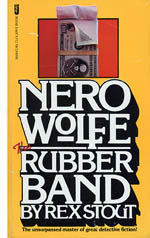
The Rubber Band, as a book title, wouldn't appeal to me, but I'll read any Nero Wolfe book by Rex Stout. Mr. Stout is a masterful puzzle maker. I enjoy trying to solve the puzzles before Nero explains everything in the end. I usually end up following red herrings and get distracted by false leads, but I always enjoy the ride.
The titular Rubber Band was a band of men, lead by "Rubber" Coleman, who helped a man escape from hanging. The escapee promised the men half of what he would inherit, a considerable bounty. The story picks up some forty years later when the daughter of a deceased band member consults Nero Wolfe. There are too many facets of the story to reveal here, but suffice it to say, it was a fun read. I recommend the entire Nero Wolfe collection.
I don't like rating books by a star or number system, so here's my rating system:
Bad=Quit reading the book
Fair=It was okay; I finished it
Good=I liked it
Great=I loved it; definitely would enjoy re-reading it someday
Rating for The Rubber Band: Great
Sidekick: Archie Goodwin
The Rubber Band, as a book title, wouldn't appeal to me, but I'll read any Nero Wolfe book by Rex Stout. Mr. Stout is a masterful puzzle maker. I enjoy trying to solve the puzzles before Nero explains everything in the end. I usually end up following red herrings and get distracted by false leads, but I always enjoy the ride.
The titular Rubber Band was a band of men, lead by "Rubber" Coleman, who helped a man escape from hanging. The escapee promised the men half of what he would inherit, a considerable bounty. The story picks up some forty years later when the daughter of a deceased band member consults Nero Wolfe. There are too many facets of the story to reveal here, but suffice it to say, it was a fun read. I recommend the entire Nero Wolfe collection.
I don't like rating books by a star or number system, so here's my rating system:
Bad=Quit reading the book
Fair=It was okay; I finished it
Good=I liked it
Great=I loved it; definitely would enjoy re-reading it someday
Rating for The Rubber Band: Great
Monday, January 30, 2012
The Case of the Curious Bride
Hero: Perry Mason
Heroine: Della Street

It's not a romance. It's a Perry Mason mystery. I love these books. I've never read one I didn't like.
In this one, Rhoda Montaine is arrested for murdering her first husband, Gregory Moxley. Her current husband Carl is ready to testify against her. Rhoda walks into the D.A.'s trick, and claims she was ringing the doorbell outside when the murder allegedly took place. Since a defense of self-defense is off the table, Perry must use his wit and wiles to come out a winner in the end. He's so smart; that's why I love him.
I don't like rating books by a star or number system, so here's my rating system:
Bad=Quit reading the book
Fair=It was okay; I finished it
Good=I liked it
Great=I loved it; definitely would enjoy re-reading it someday
Rating for The Case of the Curious Bride: Great
Heroine: Della Street

It's not a romance. It's a Perry Mason mystery. I love these books. I've never read one I didn't like.
In this one, Rhoda Montaine is arrested for murdering her first husband, Gregory Moxley. Her current husband Carl is ready to testify against her. Rhoda walks into the D.A.'s trick, and claims she was ringing the doorbell outside when the murder allegedly took place. Since a defense of self-defense is off the table, Perry must use his wit and wiles to come out a winner in the end. He's so smart; that's why I love him.
I don't like rating books by a star or number system, so here's my rating system:
Bad=Quit reading the book
Fair=It was okay; I finished it
Good=I liked it
Great=I loved it; definitely would enjoy re-reading it someday
Rating for The Case of the Curious Bride: Great
Wednesday, April 13, 2011





Tuesday, February 1, 2011
Valentine's Day-themed light decorations


We have a dining room light.

It used to have sixteen flat glass panels suspended from a metal framework. Then one day, someone threw a tennis ball for the dog. (I won't say who, but I'm 95% sure it was me.) One of the panels fell onto the table and shattered. To make matters worse, we were working on a 1000-piece puzzle on that very table. It was a big mess. (The table still has a nick from where the sharp glass corner hit.)
Unsatisfied with a light fixture that was missing a piece, I took it upon myself to make new panels. Inspired by the look of punched tin pie safes, I decided to make something similar. I found some metal (I have no idea what we used it for; it's corrugated and white on one side) in our garage and cut it to match the size of the glass (4"x8"). I made a punch-out template on the computer and taped a copy to each metal panel. Then I got to work punching. It took awhile, but I got the job done.

I really wanted to spray-paint the gold light fixture white, but my dad and mom nixed that idea. It is their house after all.


Anyhow, I've digressed. I did all that a couple of years ago. Back to the present. I made some Valentine's Day themed panels. I saw an idea for greeting cards using crayon shavings and waxed paper, and I thought the same idea would work well for our light fixture. If I had known what a time- and labor-intensive project it would be, I probably would have skipped it. Initially, I thought I'd be able to use a paper-punching machine to cut out hearts, but I couldn't gain access to a heart punch. I know some people have Cricut or Silhouette machines; those would have simplified the project immensely. I did it the old-fashioned way: scissors. I used a paper cutter and cut out 32 4"x8" panels. (I used pink copier paper.) I took scrap paper, folded it in half, and cut out hearts until I got one I liked. I used that scrap heart and traced around it on one of the panels. I used a hole-puncher to make an opening for my scissors to fit into, and then I cut out the inside. I used that as my stencil for 16 other panels. I got smart and put two panels together and cut them out at the same time, so I wouldn't have to stencil or cut out 32 separate panels. With that done, I cut waxed paper into 4" squares. (I folded the waxed paper so I had cutting guidelines.)

I got my crayons out. Luckily they were in a box with a built-in sharpener.

I opened the bottom of the box and dumped out the old shavings.

I picked out crayons that were in the red color family.

I didn't use them all, but it was easier for me to have them all together to pick from.

I sharped the crayons and let the shavings fall on the back of a paper plate.

I spread out eight waxed paper squares and sprinkled on half of the shavings. (I also sprinkled on some glitter to see what would happen.)

I topped the squares with more waxed paper and covered everything with a paper towel. I used an iron to melt the shavings together.

Once the first batch was done and cooled, I repeated the process. (I didn't add glitter this time.) I recommend having newspaper or paper towels between the waxed paper and your table; it makes clean up easier.
One by one, I laid the waxed squares on top of the pink panels. I pivoted the squares so that the cut-out area had a good view of the melted color. I traced (free-handed) a larger diameter heart onto the waxed paper and cut the squares into hearts.
I pulled out the rubber cement, spread it over the pink panel, added the waxed heart, and topped with another pink panel.
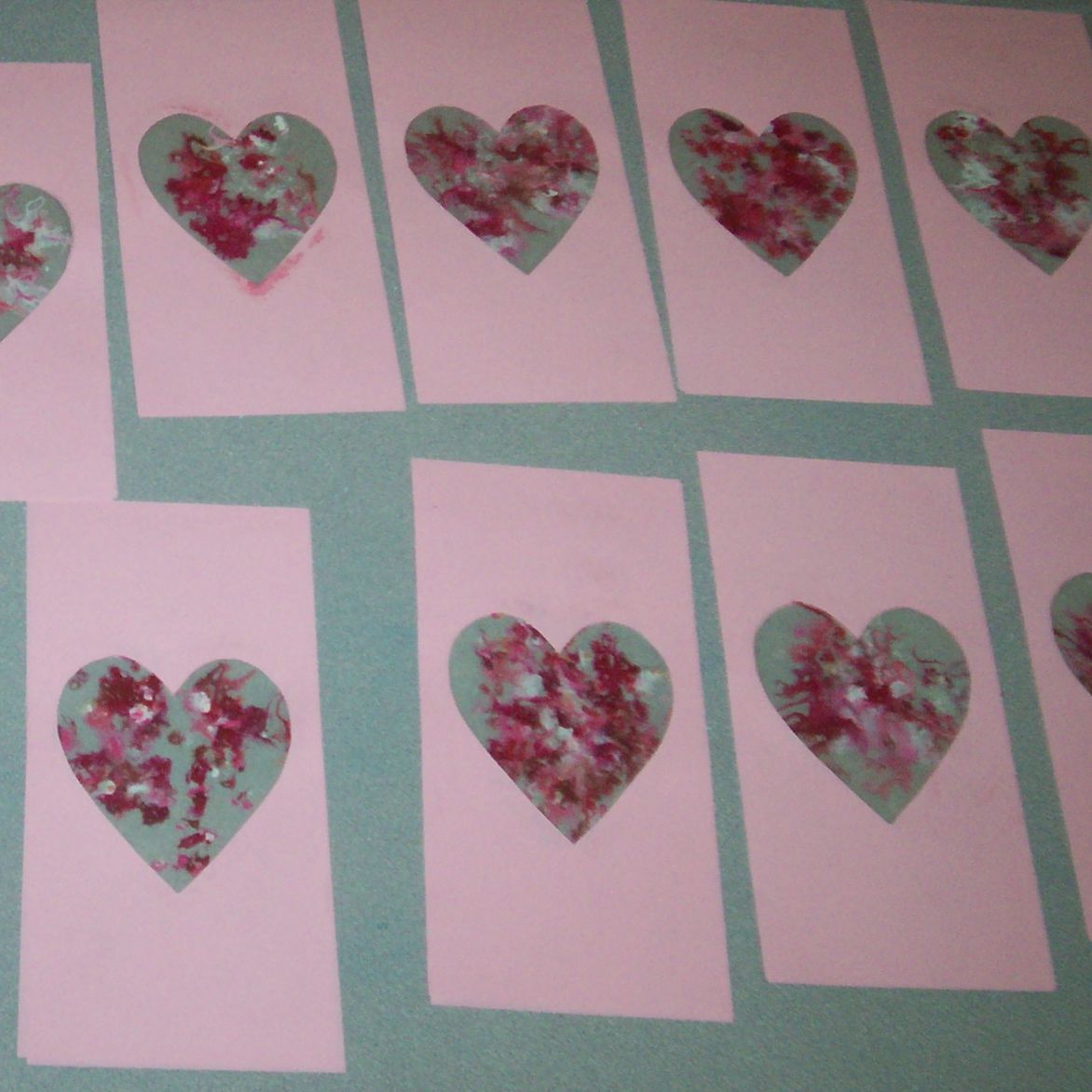
I did that sixteen times. (Have I mentioned it was a time- and labor-intensive project?) I used a metal panel to trace out where the hanging hole needed to be.

Then I realized my hole puncher would not reach that deep. I punched where I could, and then erased the trace marks. I rubbed off excess rubber cement and hung the panels.


Please note, I have no idea if this is a fire hazard or not. We use energy-efficient bulbs, which I think are cooler temperature-wise than traditional light bulbs. The paper panels do not touch the bulbs, so I think it's safe. I only point this out because my dad wondered about potential fire danger.
Linked to Funky Junk Interiors Chandelier Special
Subscribe to:
Posts (Atom)